Planning Your Vietnam Trip

vietnam itinerary planning can be confusing

How Long to Spend in Vietnam?

Deciding on the length of your Vietnam itinerary is a key part of the planning process. While you could spend months exploring this fascinating country, most first-time visitors find that two weeks is a good amount of time to see the main highlights without feeling too rushed. This allows you to travel from north to south and experience the diverse regions.

Ultimately, the best way to determine your trip length is to consider your interests, budget, and travel style. Whether you have one, two, or three weeks, you can create a memorable journey. 

Typical Itineraries: One, Two, and Three Weeks

A one-week trip usually focuses on a single region, either the north and centre (Hanoi, Ha Long Bay and Hoi An) or the south (Ho Chi Minh City and the Mekong Delta). This allows for a more immersive experience without spending too much time on travel.

A 10 day to two-week itinerary is ideal as it allows you to see the highlights of all three regions. You can fly into Hanoi, travel down through Central Vietnam – Hoi An and possibly Hue, and fly out of Ho Chi Minh City. This timeframe gives you enough time to enjoy each location, including an overnight cruise in Ha Long Bay, without feeling rushed.

With three weeks or more, you can explore at a more relaxed pace and venture off the beaten path. This could mean adding destinations like Sapa in the north, the beaches of Mui Ne or Phu Quoc Island, or spending more time in the Mekong Delta. Perhaps it’s worth including Cambodia or Laos in your itinerary? 

The Geography of Vietnam

Exploring the country reveals distinct regional characteristics, with South Vietnam, Central Vietnam, and the North each offering unique experiences. Understanding these differences is key to planning your perfect trip. 

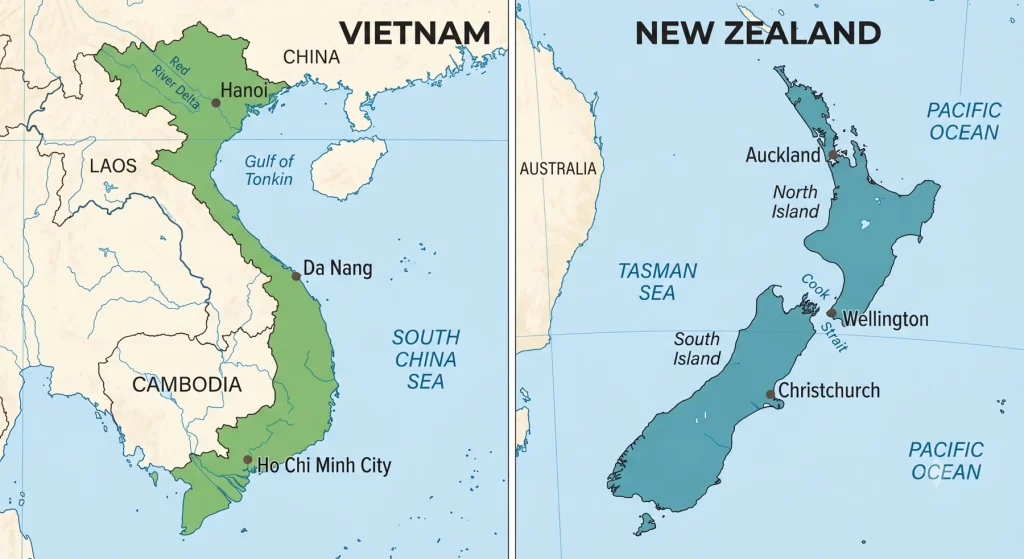
Vietnam New Zealand map


Vietnam stretches over 1,650 kilometres from north to south (just longer than NZ’s North and South Islands combined). Much like New Zealand, the landscape changes dramatically as you travel through the country. In Northern Vietnam, you will find rugged highlands, majestic snow-covered mountains in winter, and iconic terraced rice fields that create breathtaking vistas. This region is a paradise for trekkers and nature lovers.

Moving to Central Vietnam, the country narrows, revealing a stunning coastline with white-sand beaches near cities like Hoi An, Danang and Nha Trang. This area is perfect for those who want to combine cultural exploration with beach relaxation. Further inland, you’ll find the historic imperial city of Hue, surrounded by lush hills and the Perfume River.

In the south, aside from the megacity of Saigon (Ho Chi Minh City), the landscape is dominated by the vast Mekong Delta, a maze of rivers, swamps, and islands. This “rice bowl” of Vietnam is incredibly fertile, with floating markets and villages that offer a unique glimpse into river life. 


Deciding Where to Start Your Vietnam Journey

There’s no set rule – you can start your Vietnamese adventure in the north, the centre or the south. Hanoi (north), Danang (centre), and Ho Chi Minh City (south) or Phu Quoc Island (south of Cambodia) all have international airports. The choice of where to start often depends on your travel style and what you want to see first. 

Deciding on your entry point will shape the flow of your itinerary. Are you looking to ease into your trip with ancient temples and serene lakes, or do you prefer to jump right into the vibrant energy of a sprawling city?

Factors to Consider When Planning Your Route

When planning your route, your travel interests and the amount of time you have are the most important factors. If you’re passionate about history and culture, you might want to allocate more time to exploring the ancient town of Hoi An and the imperial city of Hue. If nature and adventure are your priorities, you could focus on areas like Ninh Binh (a few hours from Hanoi) or the northern mountains.

Transportation options will also influence your itinerary. Domestic flights are the fastest way to cover long distances, although some people opt to take the train, particularly if you want to experience a sleeper train between cities. 

Consider these points when planning your route:

  • Travel Pace: Do you prefer to see a lot quickly, or do you like to immerse yourself in a few key locations, or take time out for some rest and relaxation? This will determine how many stops you can realistically make.

  • Interests: The majority of first time visitors will focus on the country’s highlights and maybe add a few of their interests along the way. You can also prioritise destinations that align with your interests, for example: a foodie will base the itinerary around culinary experiences, a golfer will follow the courses, while a history buff will focus on historical sites. 

Putting it All Together

Planning your first trip to Vietnam can feel daunting but that’s what we are here for. We’ll talk through your wishlist (if you have one) and suggest things to create an amazing Vietnam itinerary for you. Don’t spend hours researching on the internet when we can answer your questions from our own experience and years of itinerary planning.

Have a question about PLANNING YOUR TRIP?

Use this form if you’d like to be contacted.
Feel free to phone or email if you’d prefer.

This site is protected by reCAPTCHA
Our Privacy Policy and Booking Terms and Conditions apply.

Frequently Asked Questions

Should I skip any destinations for a first visit?

While it’s tempting to see everything, focus on a few key destinations like Hanoi, Hoi An, and Halong Bay for your first visit. If time permits, add in Ho Chi Minh City (Saigon), followed by something that piques your interest, like the northern hill tribe areas, beach stays, or cultural interests in Hue and the Mekong.  This allows for a more relaxed exploration and understanding of Vietnam and avoids the overwhelm of too many places.

Is two weeks enough for Vietnam?

Yes, that’s a great average length of time. You can see a lot of Vietnam’s highlights without rushing and having enough time to relax and enjoy. 

Should I fly or take the train between cities?

Flying is faster and more comfortable. My thoughts are that if you want the experience of a basic overnight train journey in South East Asia then include it otherwise just fly. 

How many nights should I spend in Hanoi, Halong Bay, Hoi An and Saigon (Ho Chi Minh City)?

Three nights generally means you get two full days – one day to go sightseeing and one day to relax and enjoy your surroundings. So in short, three nights in Hanoi, an overnight Halong Bay cruise, three (or more if you want some relax time) in Hoi An, then two or three nights in Saigon, depending on what you’d like to see there. 

Is one night on Halong Bay enough, or should I do two?

Generally one night is fine. One of the big highlights is seeing the colours change of the limestone karsts, particularly at dusk and dawn. Note that generally on day two of most two-night / three-day cruises you’ll be exploring part of Halong Bay by tender and not be relaxing on the main ship. The main ship returns back to Halong Bay to drop off the overnight passengers and then returns with new passengers. 

Can I combine Vietnam with Cambodia or Laos?

Absolutely. We can add either or both Cambodia and Laos before or after Vietnam. Typically you’d fly between countries unless you’re on a multi-day cruise on the Mekong Delta between Vietnam and Cambodia. 

Is Vietnam a good destination for older travellers or families with kids?

Yes it’s a very family friendly destination. For older travellers it can be very comfortable too although we’d match hotels and the itinerary according to their mobility. Have a look at our multi-generational family holidays page for more information.

Should I do a group tour or travel independently?

Both are great options depending on what you are looking for. Read our  thoughts on group tours, independent travel as well as cruising. 

How far ahead should I book?

Most people book up to 11 months in advance. On average probably 6 to 8 months out but there’s no problem booking much closer to your travel date. 

Do New Zealanders need a visa for Vietnam?

Yes, New Zealander citizens need a tourist visa to enter Vietnam. This is usually applied for online, even for a short holidays. The good news is that Vietnam’s e-visa system makes this a straightforward, entirely online process. Have a read of our Vietnam Visa information for more details.